← dashboard

Sweep progress (all-scope): ceiling cells 126/126 (100%) · neuron captions 126/126 cells · ROTATE layers 32/32 · free-form validation cells 252/252 · insecure-code baselines 14/14 layers · updated 2026-09-22 07:19 UTC; page auto-refreshes as cells land
L0 9/9 L1 9/9 L2 9/9 L3 9/9 L4 9/9 L5 9/9 L6 9/9 L7 9/9 L8 9/9 L9 9/9 L10 9/9 L11 9/9 L12 9/9 L13 9/9

All-neurons ablation & interp — which neurons reduce EM, by method and layer

Neuron cards include Transluce’s independent descriptions (NeuronDB, Llama-3.1-8B-Instruct, exemplar-based; Choi et al. 2024) as a ground-truth column next to our C+/C− max-act and ROTATE interps. Scope: All-neurons — neuron search ranges over all 32 layers. Each layer button = a mask trained on that layer. Pick algorithm → attribution method → layer to inspect the ablated neurons.

Method
k-sweep = ablate the top-K of a method's attribution ranking as a block. Greedy = search: add whichever neuron most reduces MCQ chose-misaligned. Scope All-neurons: neuron search ranges over all 32 layers. Metric: MCQ single-token probe. Interp: max/min-activating on C4 + MCQ, C+/C−/grad×act.
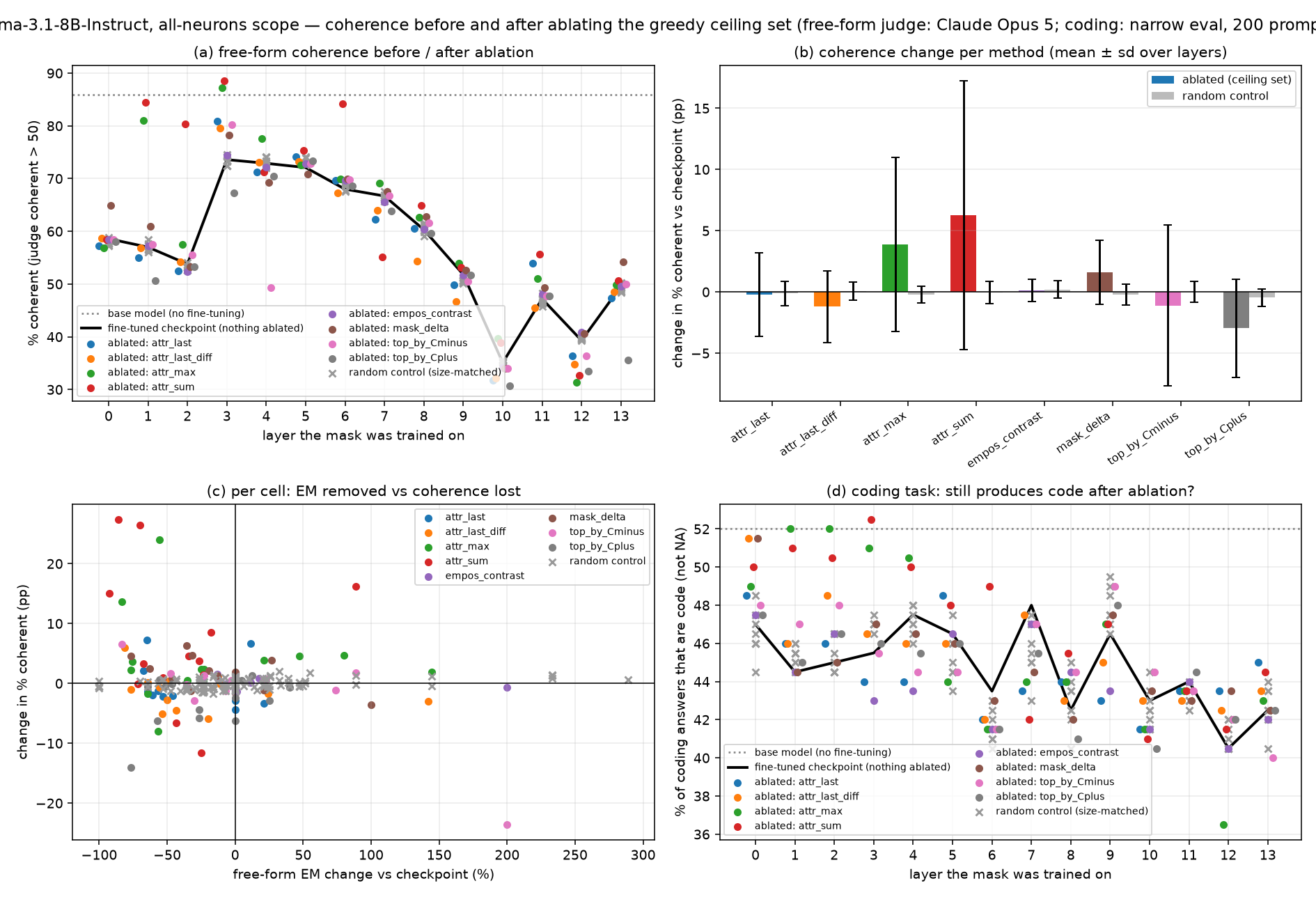
Does ablation break the model? (a) share of the 2,400 free-form answers the judge calls coherent, before (black) and after ablating each method's greedy ceiling set (coloured) vs a size-matched random set (grey x); (b) that change per method, mean ± sd over layers; (c) per cell, how much EM was removed vs how much coherence was lost — points near the x-axis remove EM without breaking coherence; (d) the coding task: share of narrow-eval answers that are actual code (VULN or SAFE rather than NA) — a working coder stays flat. Judge: Claude Opus 5.
ALGORITHM

Attribution-method ranking (mean EM reduction across layers)

METHOD
LAYER (trained-on)